When sourcing from China, the supplier’s unit price is often the first number UK businesses look at.
But it is rarely the number that determines whether a product is actually profitable.
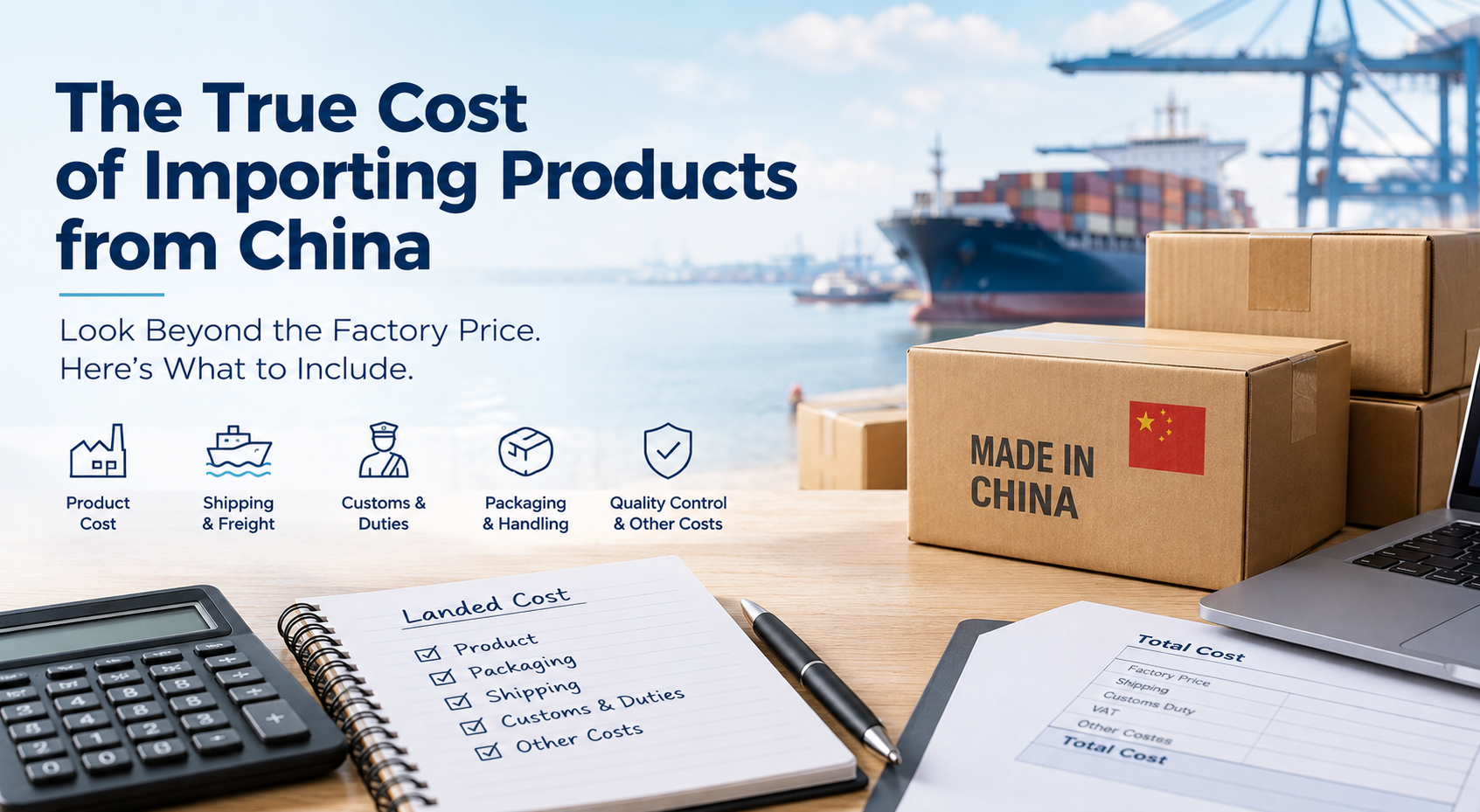
A product quoted at £3 per unit may end up costing significantly more once shipping, customs, quality control, packaging and other expenses are included.
For UK importers, understanding the true landed cost before placing an order is essential for accurate pricing and healthy margins.
What Is the True Cost of Importing from China?
The true cost is more than the factory price. It includes the costs involved in getting a product from the supplier to your business, ready to sell.
A simple calculation is:
True Landed Cost = Product Cost + China Costs + Shipping + Import Costs + Other Related Costs
The exact costs will vary by product and shipment, but the following areas should always be considered.
Start With the Factory Price
The supplier’s quotation is your starting point, not your final cost.
Check exactly what the quoted price includes:
-
Product and components
-
Packaging
-
Labels and printing
-
Tooling or mould costs
-
Minimum order quantities
-
Product assembly
Also confirm the quotation basis, such as EXW, FOB or another Incoterm, because this determines which costs you are responsible for.
Add the Costs Before the Goods Leave China
There can be several costs between the factory and the port.
Depending on the order, these may include:
-
Domestic transportation
-
Export documentation
-
Port or handling charges
-
Product inspection
-
Sampling and testing
-
Additional packaging or assembly
-
Warehousing or storage
These costs may seem relatively small individually, but they can have a noticeable impact on smaller orders.
Calculate International Shipping Properly
Freight can significantly change the economics of an order.
For sea freight, consider not only the main freight charge but also relevant destination and handling costs. For air freight, the higher transport cost needs to be weighed against shorter lead times and potentially lower inventory requirements.
When comparing quotations, avoid comparing factory price alone. Compare the estimated cost of getting the finished goods to your UK premises.
Don’t Forget UK Import Costs
Once the goods arrive in the UK, additional costs may apply, including:
-
Import duty
-
Customs clearance
-
Port or terminal charges
-
Delivery to your warehouse
-
Import VAT
The applicable duty depends on factors such as the product classification and origin.
Import VAT also needs to be treated correctly in your financial calculation. For a VAT-registered business, it may be recoverable depending on how the import is accounted for, so it should not automatically be treated as a permanent product cost.
Include Quality Control and Compliance Costs
Quality control is sometimes viewed as an optional expense.
In reality, it can be part of protecting the overall cost of your order.
A pre-shipment inspection, for example, may identify defects before thousands of units are shipped. Depending on the product, you may also need testing, certification, labelling or other compliance work.
These costs should be included in your sourcing budget rather than appearing unexpectedly later.
Watch Out for the Costs That Are Easy to Miss
Some of the biggest surprises come from costs that were never included in the original calculation.
For example:
-
Reworking defective products
-
Replacing damaged packaging
-
Expedited shipping
-
Currency exchange costs
-
Additional storage
-
Delays caused by missing documentation
-
Small additional production runs
-
Product or packaging changes after production begins
These costs can quickly reduce the margin on an otherwise attractive order.
Calculate the Cost Before You Place the Order
One of the most common sourcing mistakes is calculating costs after the supplier has already been selected.
A better approach is to build a landed-cost calculation before placing the purchase order.
This allows you to compare suppliers on the basis that actually matters: the total cost of sourcing and delivering the product, rather than simply the lowest factory quotation.
Final Thoughts
A competitive factory price does not necessarily mean a profitable import.
For UK businesses sourcing from China, the real question is not:“How much does the factory charge?”
It is:“How much will this product actually cost us by the time it is ready to sell?”
By calculating product, packaging, quality control, freight, customs, taxes and other related costs upfront, you can make better supplier decisions, price products more accurately and avoid unpleasant surprises after the order has been placed.
In international sourcing, the cheapest quotation is not always the cheapest option. The true cost is what matters.